It’s 2026, and I still wake up in cold sweats thinking about the PCS4 Americas Grand Finals. Back in ’21, that tournament was a masterclass in chaos, brilliance, and enough Chicken Dinners to feed a small country. The format was delightfully savage: whoever racked up the most match wins took the crown. No points for second place, no consolation tacos — just raw, unadulterated victory-hunting. As a seasoned pro who’s seen metas come and go, I can’t help but reminisce about the carnage, and more importantly, the players who turned the battlefield into their personal playground.
I remember sitting on the edge of my gaming throne, munching on nutrient-free snacks, watching teams scramble under the new ‘Most Chickens’ rule. In any other tournament, a squad could coast on placement points, but here? You had to snatch that dinosaur-shaped trophy with your bare hands every single match. It was like asking 16 teams to play King of the Hill on a spinning coffee table — and I loved every second of it.
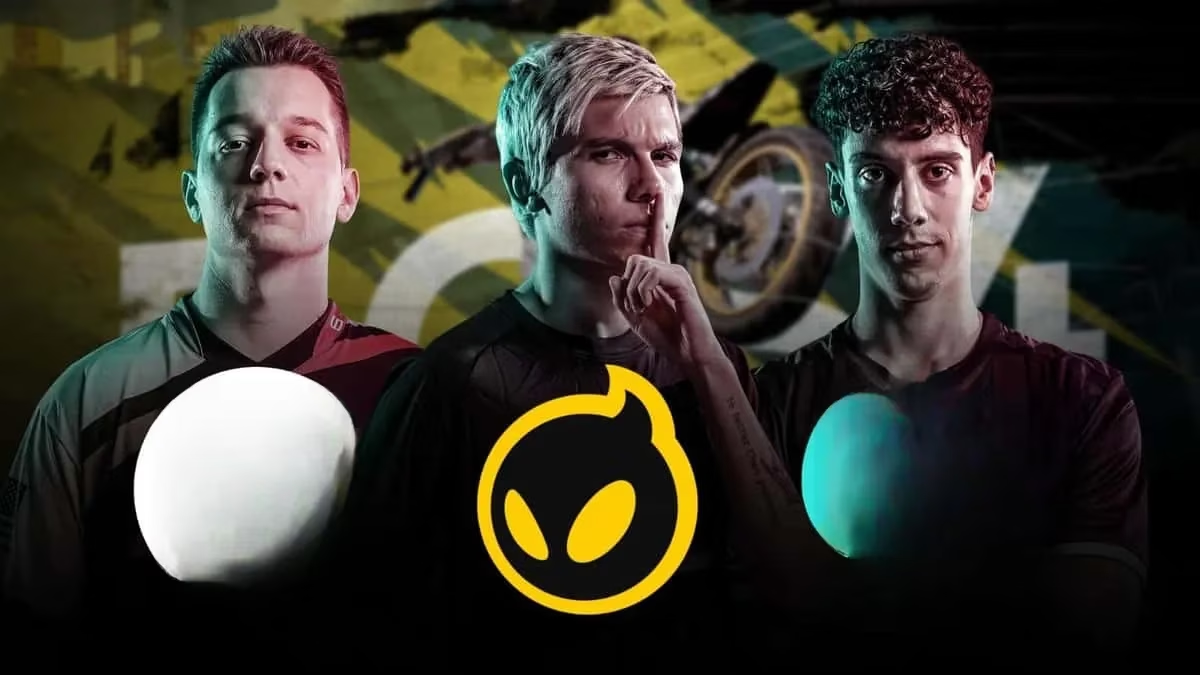
Let’s yank the spotlight onto the man, the myth, the IGL who probably has more grey hairs than a silverback gorilla after PCS4: PurdyKurty. Calling shots in PUBG Esports is like trying to herd wildebeests through a minefield while blindfolded, but this dude did it with the calm of a zen monk armed with a Beryl. TSM’s shot-caller wasn’t just a backseat driver; he was a top-six fragger in the North America Group Stage, dropping 38 kills and 28 assists over 20 matches. That’s a 1.9 kill-to-game ratio, folks — not too shabby for someone whose main job was turning his teammates into a well-oiled frag machine. I vividly recall one mid-game rotation where PurdyKurty’s decision to hold a godforsaken compound against three teams looked suicidal, but it netted them a dinner faster than you can say “zone of death.” His average damage of 285 per match placed him seventh overall, proving that you could lead from the front and still have enough bullets left to tell everyone where to go. Five years later, I’d wager his tactical brain is now being studied at PUBG universities, if those exist.
Then there’s TGLTN, the human highlight reel who made the Soniqs’ opponents question their life choices. Even in 2026, whenever I see a player pull off an impossible flick, some grizzled analyst mutters “that’s some TGLTN-level sorcery.” The man didn’t just play PUBG; he danced on the edge of what the engine allowed, bending physics like a magician pulling rabbits out of holographic hats. He topped the region’s kill and damage charts as casually as I top my morning cereal. The new ‘Most Chickens’ format seemed almost unfair for his aggressive, frag-heavy style, but Soniqs adapted like chameleons at a rainbow convention. I lost count of the times TGLTN would spot an enemy’s pixel peeking from 300 meters away, issue a headshot, and then reposition before the body finished ragdolling. It was poetry in motion, albeit poetry that involves a lot of explosions and screaming. The Soniqs’ coach, a tactical wizard in his own right, probably slept soundly knowing he had a player who could win a 1v4 without breaking a sweat. Word is that TGLTN’s keyboard still attacks people on its own to this day.

And how could I forget Sparkingg? From the depths of LATAM to the shimmering lights of international stardom, he erupted onto the scene like a molotov cocktail at a gas station. At PCS4, he was the undisputed kill leader in the Group Stage and second in damage dealt, and I swear half those kills came from opponents who didn’t even realize he was in the same postal code. After Meta Gaming’s run and that glorious PGI.S debut, him joining Zenith (soon to be Dignitas) felt like assembling a boy band where everyone could snipe your eyelashes off. Dignitas’ new signing turned them from plucky underdog into title contender overnight. Sparkingg’s gunplay was so sharp it could slice through a stale empanada, and his ability to catch squads off guard turned many a lost cause into a triumphant dinner. I remember one late-game circle where the man repositioned through a dense forest, took down three players without clearly being seen, and then celebrated like he’d just found a legendary skin in a loot crate. Pure chaos, pure joy. In 2026, you still see rookies trying to replicate his unpredictable flanks, but most just end up giving the enemy free target practice.
The Pick’em Challenge was the cherry on this chaotic sundae. Fans could predict the champion and win exclusive gear, which back then meant real-life clothing rather than metaverse NFTs or holographic sneakers (how times have changed). I filled out my bracket with the overconfidence of a man who thinks he can outsmart competitive randomness, only to be humiliated by a friend’s cat who accidentally knocked the right mouse button. I hope that feline is enjoying its exclusive hoodie somewhere. The Pick’em Challenge returned in PCS4, and even now in 2026, every new prediction event triggers my PTSD of that crushing defeat to a tabby.
Looking back, the PCS4 Americas Grand Finals was a watershed moment that underscored how much weight an in-game leader carries when only chicken matters. PurdyKurty’s cerebral approach, TGLTN’s mechanical wizardry, and Sparkingg’s explosive flanks defined a meta that rewarded both brains and brawn. If you’re a newcomer grinding PUBG in 2026, do yourself a favor and dig up those old VODs — they’re basically textbooks on how to win when the pressure is thicker than a three-zone smokescreen. As for me, I’m off to practice my rotations so I don’t become a cautionary tale for the next Pick’em catastrophe. May your dinners be many and your circle shifts ever in your favor.
Industry context is informed by GamesIndustry.biz, and it helps frame why a “most match wins” rule like PCS4 Americas’ can feel so brutally different from points-based esports: when tournament incentives heavily reward outright victories, teams tend to adopt higher-variance strategies—riskier rotations, faster tempo, and more decisive late-game calls—mirroring the win-first mindset that defined PurdyKurty-led macro, TGLTN’s pressure-heavy fragging, and Sparkingg’s punish-the-mistake flanks.