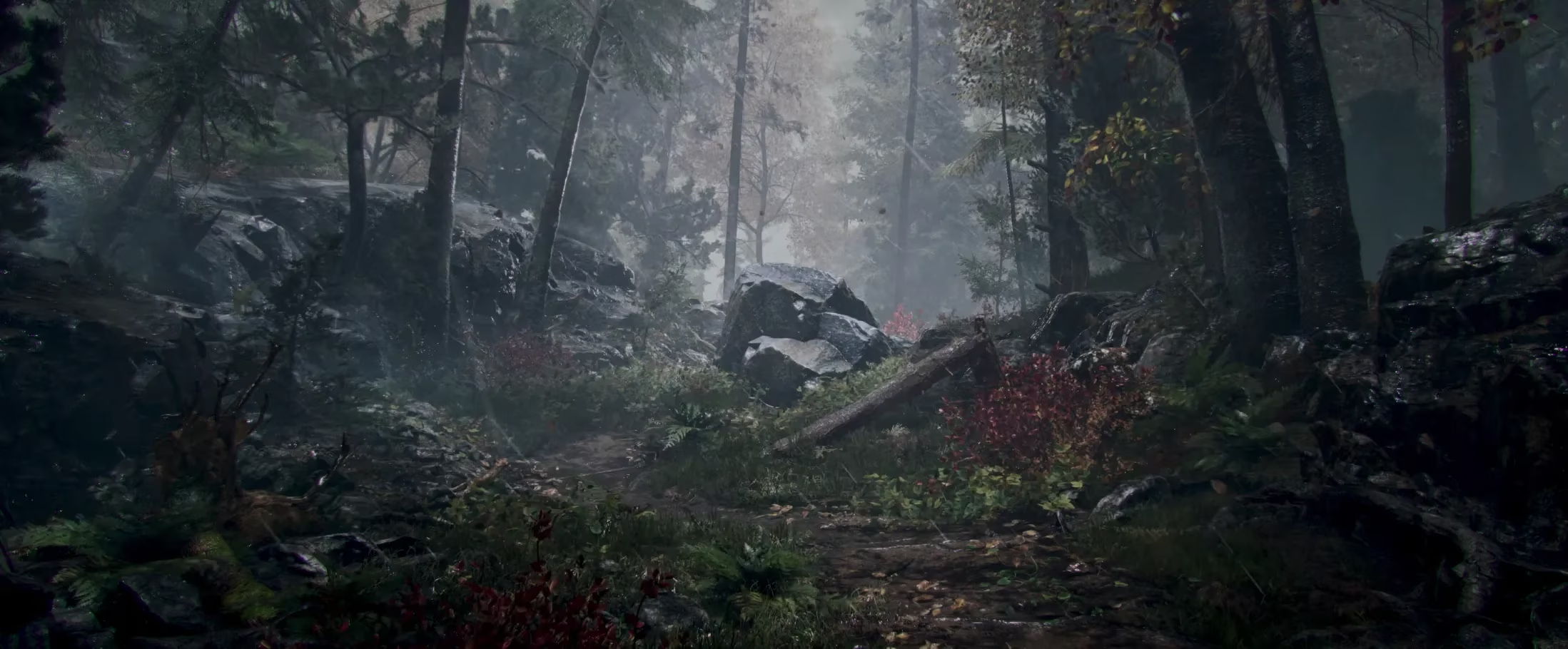
It was a cold December night in 2025, and I was hunched over my monitor, the familiar glow of The Game Awards stream washing over my face. As a professional player, I've seen countless reveals—some flashy, some forgettable. But that night, something different happened. Amidst the predictable sequels and blockbuster trailers, a brief, haunting teaser flickered across the screen. No title cards, no bombastic music, just the whisper of wind through dense forests and the crunch of footsteps on unseen terrain. It was called Prologue, and it came from the mind of Brendan Greene. My heart skipped a beat. This wasn't another battle royale. This was a promise of something entirely new from the creator who defined the genre I've spent years mastering. The teaser was a deliberate mystery, a stark departure from the chaos of PUBG, and it hooked me instantly.
I immediately dove into the sparse details available. Prologue wasn't being developed by the main PUBG Corp machine, but by a specialized experimental wing: PlayerUnknown Productions. This studio, formerly known as PUBG Special Projects, was founded with a single, thrilling mandate: to explore. Greene's own words echoed in my head: "Our studio was founded with the goal of exploring, experimenting, and creating new technologies and gameplay experiences." For someone like me, whose career has been built on mastering established systems, the idea of a studio dedicated purely to the unknown was intoxicating. This wasn't about iterating on a winning formula; it was a clean slate, a journey into uncharted design space. The studio's goal, as stated on their website, to "give players unique and memorable experiences, each and every time they play," felt like a direct challenge to the repetitive grind I often faced in competitive gaming.
The official description was beautifully vague: "an exploration of new technologies and gameplay." 🤔 What did that mean? As a pro, my mind raced with possibilities:
-
Procedural Narrative Tech? A world where every player's story is genuinely unique.
-
Advanced Physics & Interaction? Moving beyond simple loot-shoot mechanics to a world you can truly manipulate.
-
AI-Driven Environments? Ecosystems that live, breathe, and react independently of the player.
The confirmation that this would be "a brand-new experience outside of the Battle Royale genre" was the most liberating part. Brendan Greene was publicly moving on, and he was inviting us to follow him into the fog. The teaser trailer offered no UI, no guns, no other players—just a lone, first-person perspective immersed in breathtaking, yet unsettling, natural environments. It was pure atmosphere. The only call to action was a simple sign-up box on the website, a quiet request to join the mailing list and wait. This wasn't a hype machine; it was an invitation to a mystery.
Six years later, in 2025, the memory of that first teaser remains vivid. The gaming landscape has evolved, with countless studios attempting their own "experimental" projects. Yet, Prologue maintains a unique aura. While official details are still carefully guarded, the ethos of PlayerUnknown Productions feels more relevant than ever. In an era of live-service behemoths and safe sequels, the commitment to pure experimentation is a rare and valuable commodity. For me, Prologue represents the frontier. It's the antithesis of the optimized, meta-chasing gameplay that defines my professional life. It promises not a leaderboard to climb, but a world to get lost in; not a match to win, but an experience to have.
| My Professional World (Battle Royale) | The Promise of Prologue |
|---|---|
| Defined, competitive rulesets | Open-ended, exploratory systems |
| Mastering the meta | Discovering the unknown |
| Short, intense match cycles | Long-form, immersive experiences |
| Social, player-driven conflict | Solo or ambient, environment-driven engagement |
| Clear objectives (Win, Top 10) | Emergent, personal objectives |
The contrast is stark, and that's why I'm so captivated. My hands know the rhythm of a perfect loot run and the spray pattern of an M4. But Prologue whispers of a different kind of skill—patience, observation, and adaptation to systems I can't yet predict. I've signed up for every update, clinging to each cryptic piece of information. The wait has been long, but it has only deepened the intrigue. In a world where games are dissected and datamined before release, Prologue's enduring silence is its most powerful feature. It has become a symbol of potential in my mind, a reminder of why I fell in love with games in the first place: not just for competition, but for the sheer wonder of stepping into a new, unknown world. Brendan Greene's Prologue isn't just a game in development; it's a beacon for the experimental heart of this industry, and I, for one, am ready to answer its call.