The year is 2026, and anyone dropping into Erangel today might find it hard to remember a time when dying meant a one-way ticket to the lobby. But turn back the clock to mid-2021, and you'd witness an absolute earthquake in the PlayerUnknown’s Battlegrounds universe. A new map was arriving—one that would shatter a nearly three-year drought of full-sized battlefields and drag the famously hardcore battle royale kicking and screaming into the era of second chances. That map was Taego, and its arrival is still one of the most delightfully chaotic turning points in PUBG’s storied history.
Up until that point, the developers had been spoon-feeding players compact kill boxes. Sure, the likes of Sanhok, Karakin, and Paramo were fun for a quick brawl, but they lacked the sprawling, paranoid tension that only an 8x8 kilometer playground can provide. The last honest-to-goodness full-sized map had been Miramar, released way back when most players were still learning what a frying pan could do. For a game built on massive scale, going without a new big map for that long felt like asking a sniper to survive on a red dot sight alone.
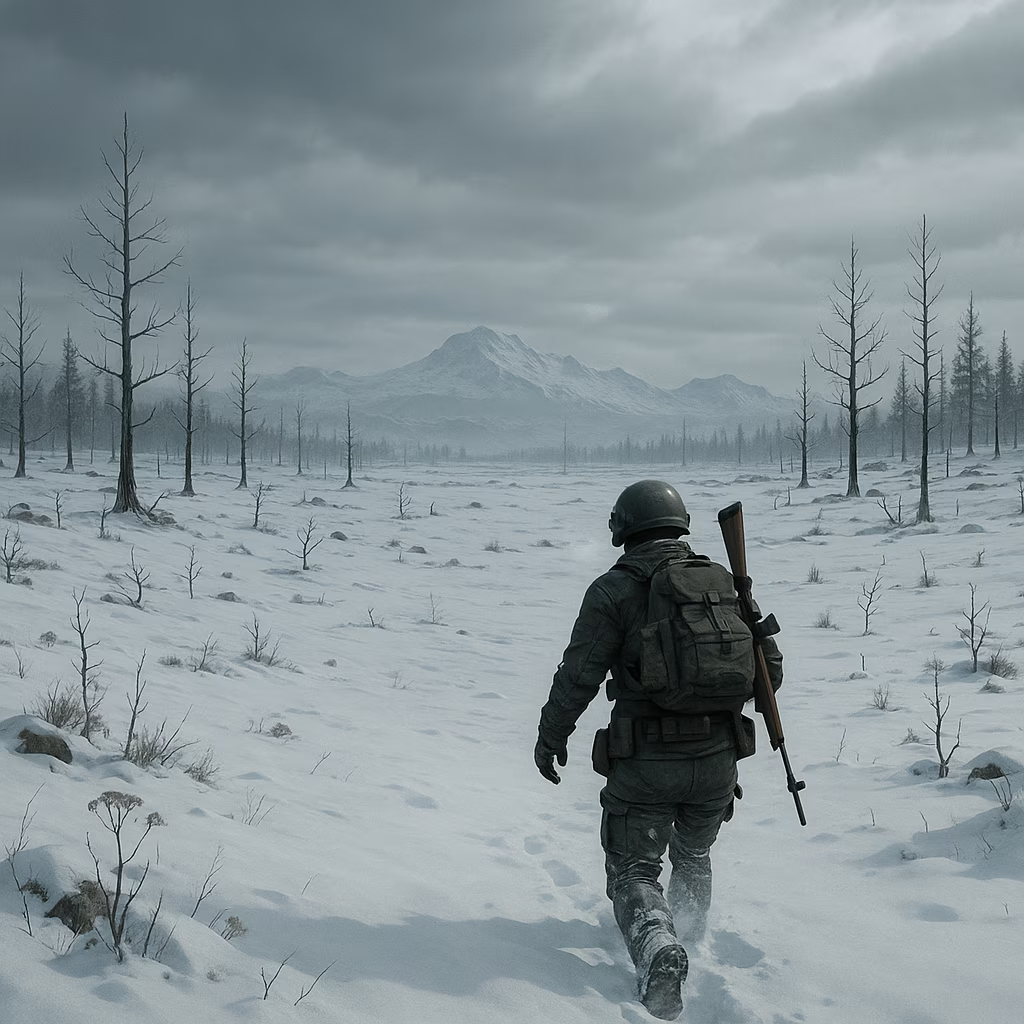
The Big One Finally Lands
Then came the announcement. Originally codenamed Project Tiger, Taego was poised to be PUBG’s first 8x8km addition since Miramar’s desert debut in 2017. The community practically vibrated with a mix of excitement and disbelief. For years, the meta had been defined by shrinking circles and frantic CQB, but Taego promised something else entirely: wide-open farmlands that could hide a kar98k-wielding ghost in every bush, rivers that begged for boat flanks, and urban clusters that gave even the most cautious players the sweats.
What really sent the rumor mill into overdrive, though, wasn’t the map’s size. It was a single word. Respawns. In a game where the phrase “Winner Winner Chicken Dinner” is permanently juxtaposed with the cold, final “Better luck next time,” a comeback mechanic sounded as alien as a friendly blue zone. But the pressure from genre juggernauts like Warzone and Apex Legends had apparently become too great to ignore. PUBG was about to give players a chance to claw their way back from the abyss.
The Gulag Comes to Town
How exactly would the dead rise again? Before the July 7, 2021 release, details were as murky as a smoke grenade corridor. Dataminers and particularly dedicated Korean forum sleuths stitched together a picture that felt ripped straight out of Activision’s playbook: a solo duel zone, a miniature prison where eliminated players would face off 1v1. If you won, you flew back into the match, gear-lite and heart pounding. If you lost? Well, at least you could spectate your squad with a fresh wave of humiliation.
When the mechanic finally went live, it didn't disappoint in the drama department. The so-called Comeback BR (as it was later refined) morphed into a distinct side-arena accessible only to those who had already tasted death. Imagine being dragged from the afterlife, dropped into a sterile holding cell with another soul who had just stuffed their last chicken dinner dream, and being told only one of you gets a return flight. The salt was palpable. The clutch moments were legendary. And for the first time, a PUBG teammate could legitimately scream, “I’m back, baby!” without using third-party software.
More Than Just a Second Life
Taego didn’t just introduce a radical new rule; it brought flavor. The map itself was a stunning homage to the Korean countryside, complete with terrace farms, dense bamboo groves, and the hauntingly quiet Hae Moo Sa temple area. Vehicles received a local twist too—the Hyundai Pony Coupe became an instant meme machine, offering both style and a surprisingly robust ability to plow through fences. A new feature, the Self-AED, allowed solo players to self-revive, which meant that even outside the respawn arena, the grim reaper had to knock twice.
Wildlife also made a debut. Those seemingly decorative birds that burst from the reeds weren't just for ambience; they were an organic, flapping early-warning system that betrayed careless movement. In a game where sound is everything, a startled flock could easily spell the difference between a clean flank and a face full of buckshot.
-
🐦 Dynamic wildlife: Alerted players to nearby footsteps
-
🚗 Exclusive vehicles: Hyundai Pony Coupe turned the rice fields into a rally stage
-
💊 Self-revive mechanic: Gave solos a ghost of a chance after a knock
-
⚔️ Comeback arena: A dedicated 1v1 zone that replayed the tension of boot camp
The Kiki Conspiracy and Beyond
While players were still figuring out the optimal drop zones on Taego, developer Krafton was already dangling another carrot. Codenamed “Kiki,” the next map was teased with concept art that promised a radical departure: a dense, rain-slicked near-future cityscape brimming with verticality. If Taego was a deep breath of fresh countryside air, Kiki (which eventually launched in early 2022) was a choked, neon-drenched exhale. Rooftop-to-rooftop gunfights became the norm, and even the most seasoned veterans had to relearn what “high ground” meant in a world of 50-story towers and drone surveillance.
Together, Taego and Kiki dragged PUBG out of its comfortable rut. They forced a player base that had grown addicted to small-map intensity to re-engage with patience, scouting, and the sheer terror of running through an open wheat field with zero hard cover.
By 2026, respawn mechanics are no longer a point of controversy—they're a standard playlist filter. You'll hear old-timers grumble about the “purity” of the early days over a bottle of energy drink in the lobby, but even they won't ditch a match that offers a Comeback Arena anymore. The gulag-style return has since been tweaked, reworked, and event-ified, but its spiritual home remains that ground-zero summer of Taego, when chicken dinners suddenly became a little less final and a whole lot more chaotic. In an industry now awash with extraction shooters and infinite redeploy, it's worth remembering that a humble 8x8 map in rural Korea rewrote the rules for the shooter that started it all.