I remember the day it was announced, a ripple through the player base I called home. The air was thick with speculation and, for some, a palpable sense of betrayal. Here we were, commanders of our storm-besieged forts, masters of crafting and cooperation, and Epic Games was unveiling a mode that felt plucked from a different world entirely. A world of 100-player free-for-alls, where the only goal was to be the last one standing. On September 26th, 2025, Battle Royale would descend upon us, promising to fuse our cherished building mechanics with the raw, unfiltered chaos of intense PvP combat. A part of me recoiled. Was this a desperate grab for popularity, a cynical clone chasing the tailwinds of another's success? Yet, another part, the part that thrills at a new challenge, felt a curious spark of anticipation.
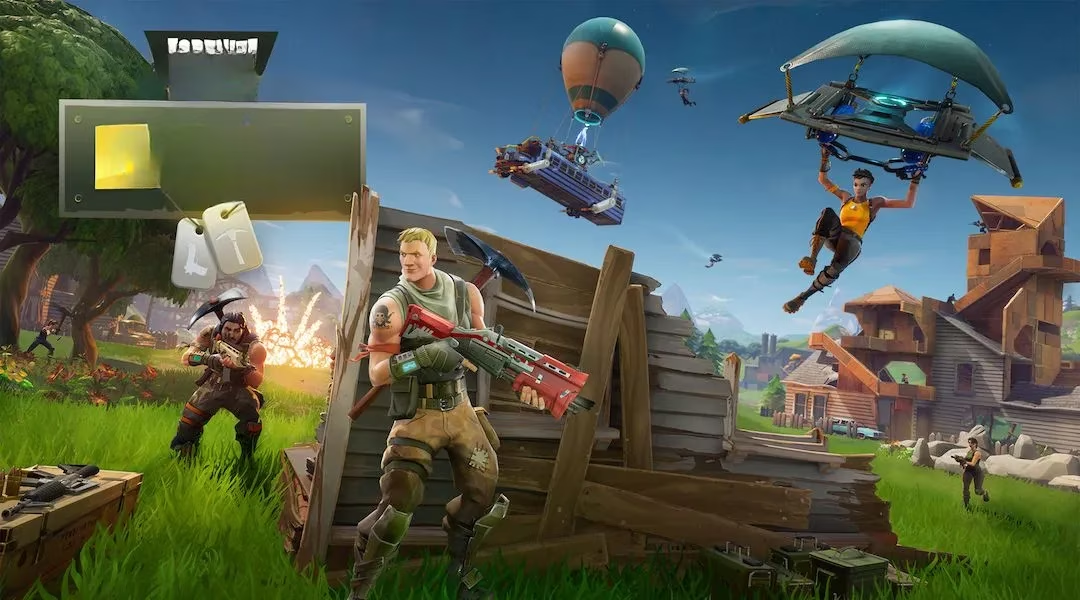
The accusations flew faster than bullets in a final circle. "Rip-off," they cried, pointing squarely at the behemoth that had captured the gaming world's imagination. The comparisons were inevitable, the shadow it cast was long and undeniable. It had sold millions, defining a genre. To announce our own foray into that arena felt, to many, like an admission—a surrender of Fortnite's unique soul for a taste of a trendy formula. I wrestled with that notion. Was inspiration merely a polite word for imitation? The developer's post claimed the Unreal Tournament team had been tinkering with this for months, a secret project growing in the shadows of our cooperative struggles. I wanted to believe that. I needed to believe Fortnite could bring something of itself to this dance, not just mimic the steps.
I joined the Public Test, bracing for the chaos Epic had warned us about. Crashes? Bugs? Servers buckling under strain? They promised it would be par for the course, and they weren't wrong. It was messy, gloriously so. But in those unstable, early moments, I saw it—the magic they had whispered about. It wasn't just about finding a weapon and hiding. It was about the panic-build when sniper fire cracked the air, frantically throwing up wooden walls as a temporary shield. It was about tunneling through a hillside for a surprise flank, or constructing a towering vantage point to survey the shrinking battlefield. The destructible environments we knew so well became a tactical playground. A house wasn't just loot; it was raw materials waiting to be harvested and reshaped into your personal fortress. This was the fusion. This was where Fortnite planted its flag.
My perspective shifted from skeptic to strategist. The Pixar-like aesthetic, once a point of contrast to its grittier rival, became a strength. The vibrant, almost cartoonish violence had a unique charm, a playful tension that felt different. And for console players, especially, this wasn't just an alternative—it was an arrival. While others waited for ports and exclusivity windows to expire, we had a battle royale, born of our own game's DNA, ready to play. The itch was there, a yearning for that last-man-standing thrill, and Fortnite offered a scratch that was uniquely its own.
**My Personal Evolution in the Royale:
**
-
Week 1: The Skeptic – Dropping in, feeling like an alien in my own game. Confusion reigned. My muscle memory was all wrong.
-
Week 2: The Learner – Embracing the panic-build. Learning that wood, brick, and metal were as crucial as a legendary scar. Deaths became lessons written in blueprints.
-
Week 3: The Adaptor – Seeing the map not as topography, but as a giant kit of parts. Mountains to tunnel through, forests to build hideouts in. The game within the game revealed itself.
-
Present Day: The Advocate – Understanding that this mode didn't replace Fortnite's soul; it added a new, exhilarating facet to it.
Looking back from 2025, it's almost humorous to recall the sheer intensity of those early debates. The mode that some feared would be a cheap clone didn't just survive its turbulent birth; it thrived, mutated, and became a cultural pillar in its own right. It proved that a genre could hold multiple giants, each with a distinct heartbeat. Epic's gamble, viewed by some as cashing in, turned out to be a visionary expansion. They took a core mechanic—building—and dropped it into the pressure cooker of battle royale, creating an alchemy that no other game could replicate. That initial million copies sold was just a foundation. Battle Royale didn't just help those figures "reach the stars"; it built a rocket ship, decorated it with llama piñatas and boogie bombs, and launched us all into a stratosphere of endless, chaotic, creative combat. I'm no longer just a commander surviving the storm. I am an architect of chaos, a sculptor of survival, and in this vast, shrinking arena, every match is a blank canvas waiting for my masterpiece—or my spectacular, explosive failure. And I wouldn't have it any other way. ✨🏗️💥
| Then (The Fear) | Now (The Reality) |
|---|---|
| A soulless clone chasing trends | A genre-defining twist with unique mechanics |
| Dilution of Fortnite's identity | Expansion of Fortnite's creative combat |
| Temporary stopgap for console players | A premier, evergreen platform for battle royale |
| Potential to split the community | A mode that brought millions into the community |
So, here I stand, years later, my inventory full of memories and metallic materials. The storms still come, and I still fight them with friends. But sometimes, I just need to dive alone into that giant, beautiful map, pickaxe in hand, ready to build my way to victory or go down in a blaze of glorious, self-constructed rubble. The journey from doubt to devotion was one of the most rewarding I've had as a player. Fortnite's Battle Royale didn't just add a mode; it added a new way to dream, to fight, and to create.